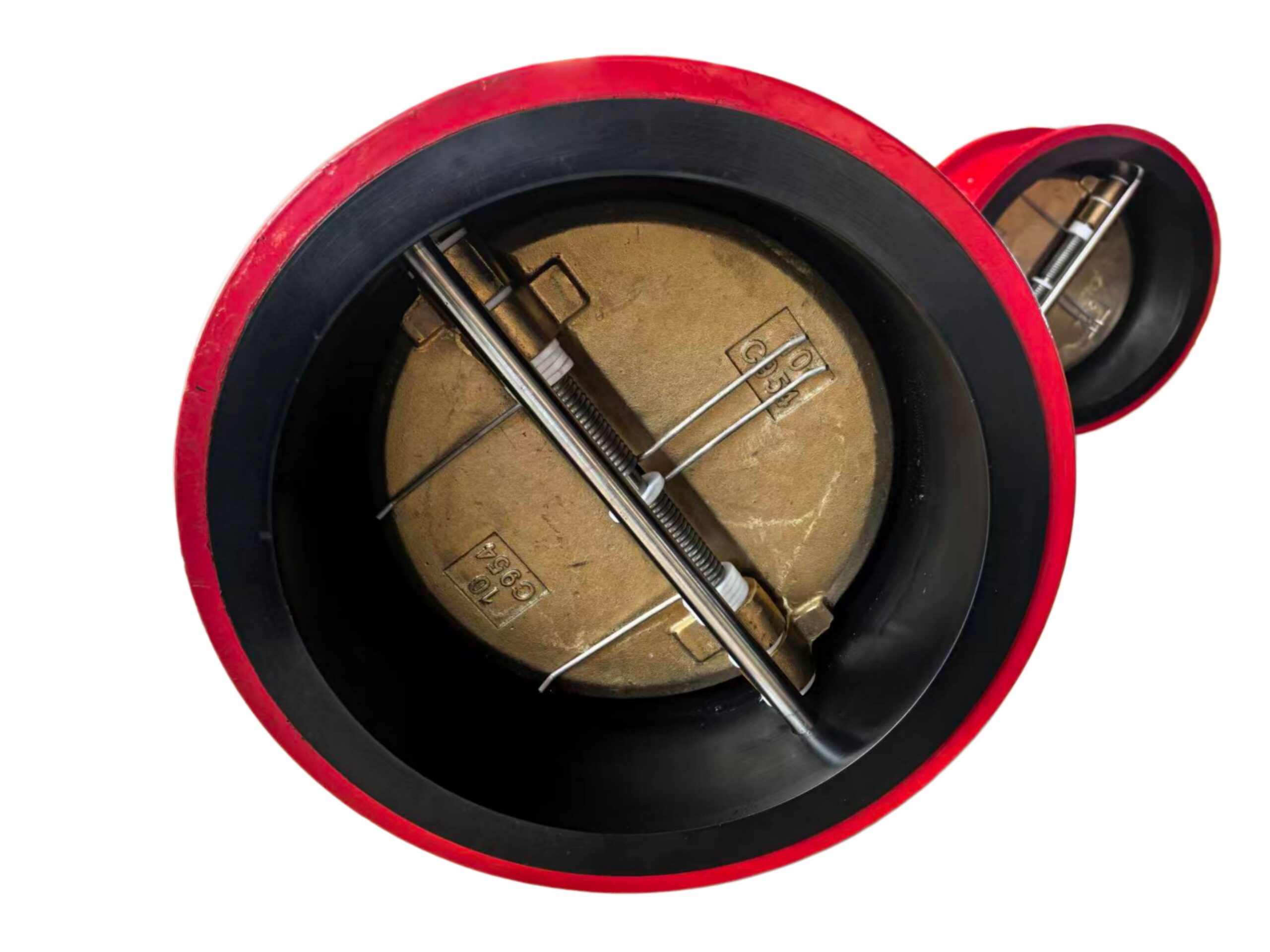
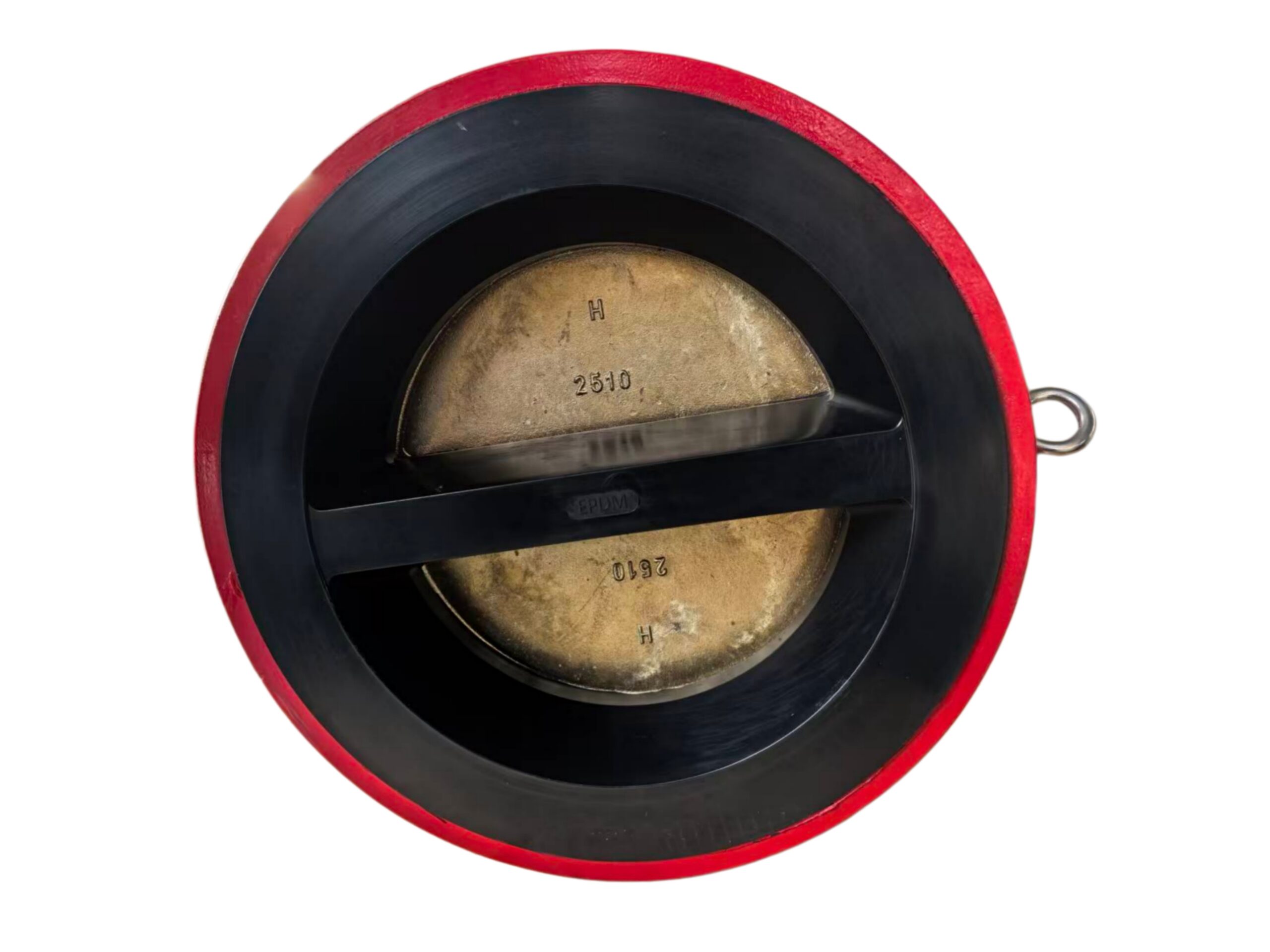
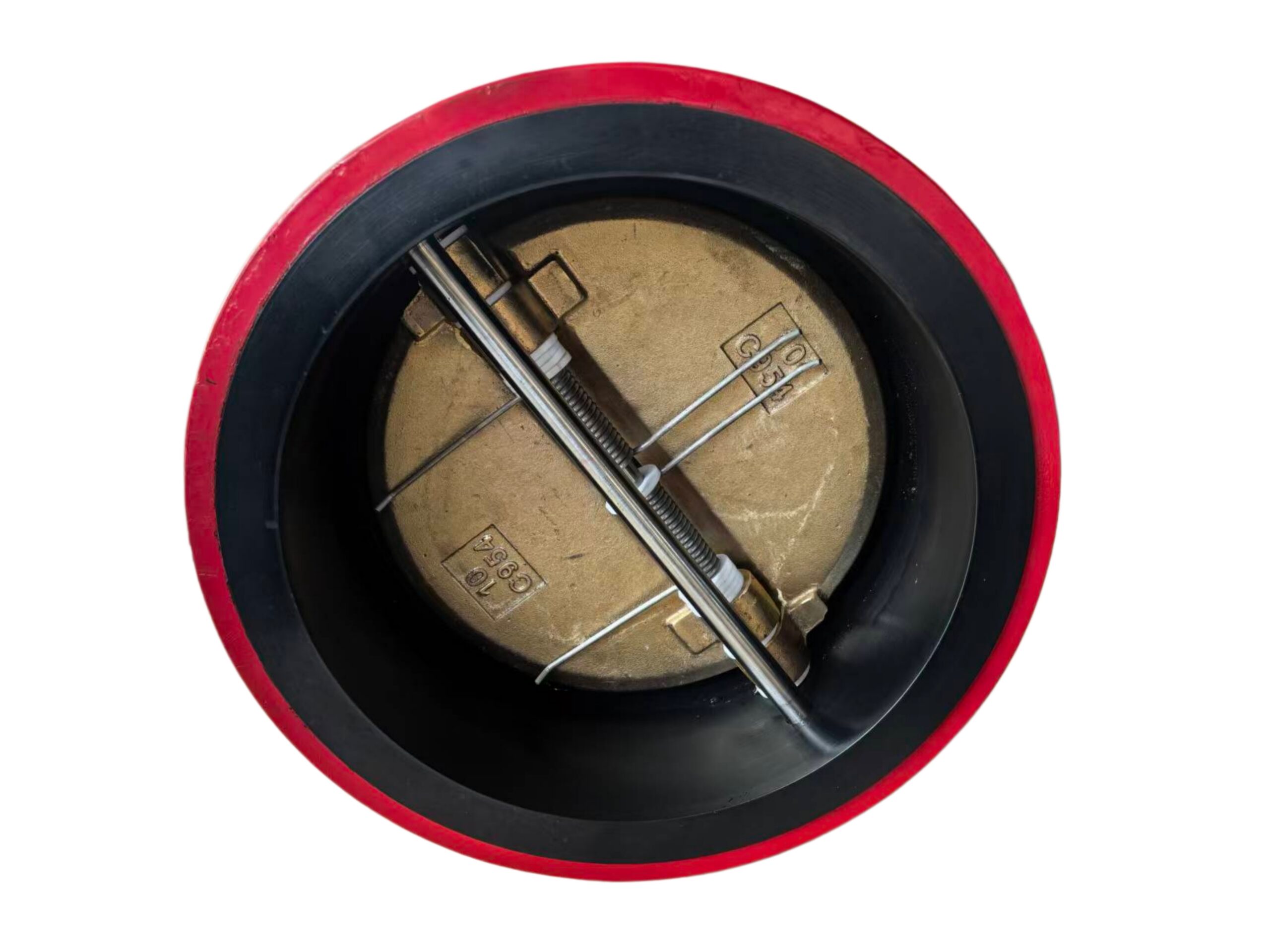
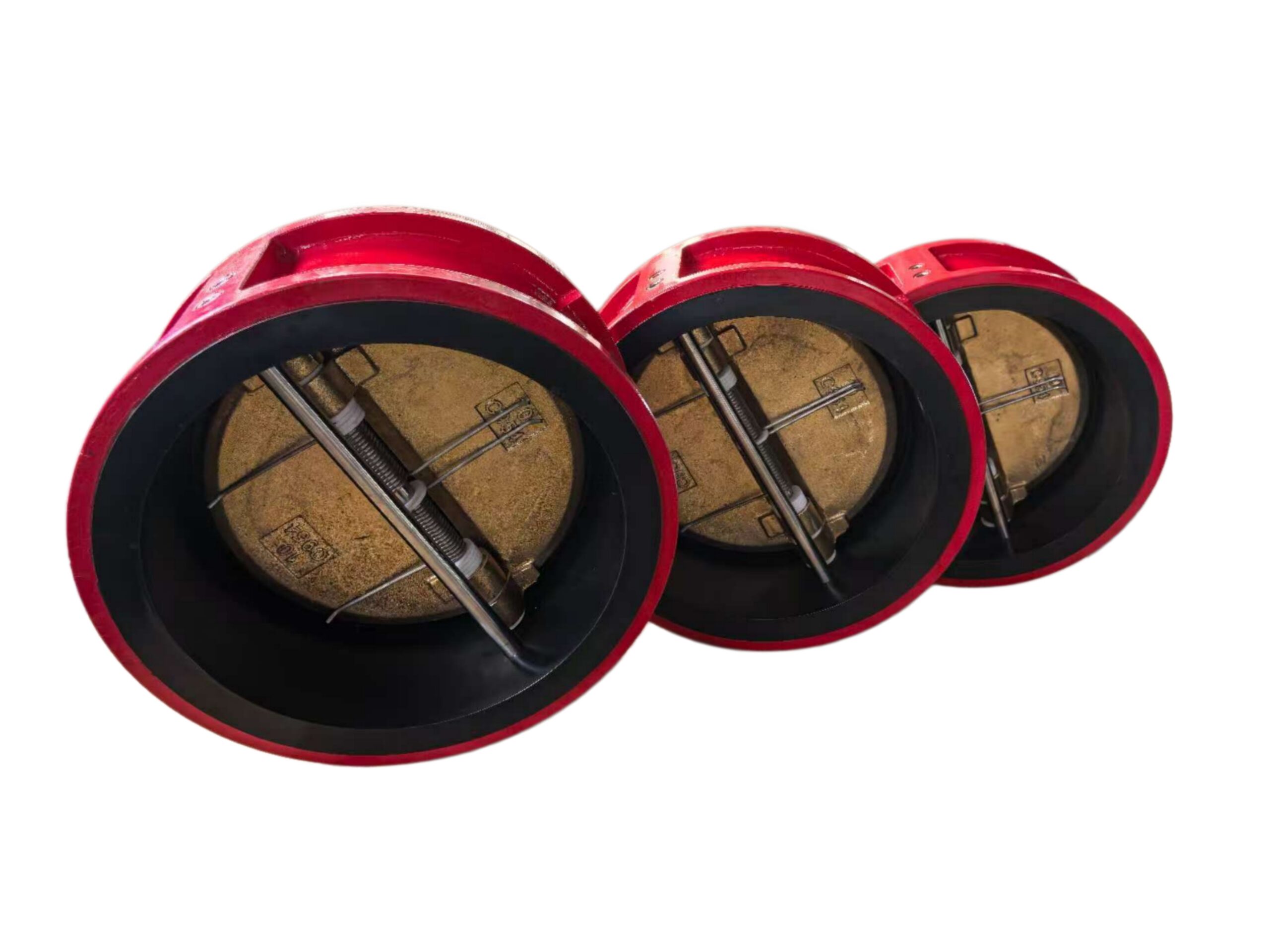
Full Rubber Lined Dual Plate Check Valve
Description
Full Rubber Lined Dual Plate Check Valve – ASTM A536 Ductile Iron, EPDM Lined, C95400 Trim
Model: DPCV-RL-DI-EPDM-C95400
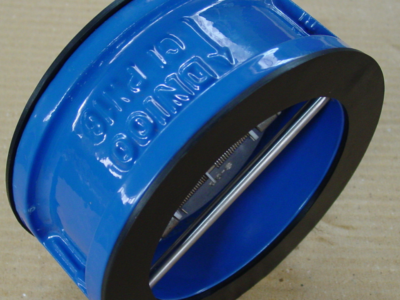
Product Description: Wafer-type, full EPDM rubber lined dual plate check valve with ASTM A536 ductile iron body and aluminum bronze (C95400) internal trim. Designed for corrosion-resistant, non-slam check service in water, seawater, and various chemical streams where full internal isolation from the process fluid is required.
1. Main Design Codes and Standards
| Item | Standard / Code |
|---|---|
| Valve Design | API 594 (Type A – Wafer), ISO 5752 |
| Face-to-Face | API 594 Short Pattern (Wafer) |
| Flange Compatibility | ASME B16.5 Class 125/150, EN 1092-2 PN10/PN16 |
| Body Material | ASTM A536 Gr. 65-45-12 Ductile Iron |
| Lining Material | EPDM (Ethylene Propylene Diene Monomer), full internal coverage |
| Trim Material | ASTM B148 C95400 Aluminum Bronze (disc plates, hinge pin, springs) |
| Testing & Inspection | API 598, ISO 5208 (for check valves) |
| Lining Integrity | ASTM D3307 spark test (≥15 kV DC, no pinholes) |
| Pressure-Temperature Ratings | Within limits of EPDM lining; body rated per ASME B16.42 (Ductile Iron) |
2. Main Technical Parameters
| Parameter | Specification |
|---|---|
| Available Size Range | 2″ (DN50) to 48″ (DN1200) |
| Pressure Class | Class 125 / 150 (PN10 / PN16) |
| Body Style | Wafer (flangeless, for installation between companion flanges) |
| Lining | 100% Full EPDM rubber lining on all internal wetted surfaces; minimum thickness 3 mm |
| Disc Type | Two spring-loaded half-discs (dual plate), C95400 aluminum bronze |
| Seat | Integral EPDM seat formed directly on the body lining (no separate seat ring) |
| Spring | Torsion spring per disc, C95400 or Stainless Steel 316 (optional), mounted on hinge pin |
| Operation | Automatic check (opened by forward flow, closed by spring + reverse flow) |
| Installation Orientation | Preferred horizontal; vertical upward flow accepted with spring closure |
| Cracking Pressure | Very low (approx. 0.03 bar / 0.5 psi) |
3. Pressure-Temperature Ratings
Limited by the EPDM lining. Ductile iron body has higher rating but service limits are set by the elastomer.
| Temperature (°C) | Max. Working Pressure (bar) – Class 125 | Max. Working Pressure (bar) – Class 150 |
|---|---|---|
| -20 to 50 | 16.0 | 20.0 |
| 80 | 12.0 | 16.0 |
| 100 | 9.0 | 12.0 |
| 120 | 5.5 | 8.0 |
| 130 (intermittent) | 3.5 | 5.0 |
Note: For continuous service above 100°C, consult factory. The valve is not recommended for steam service above 130°C or for any hydrocarbon/oil service that would swell EPDM. For vacuum conditions, the lining is mechanically anchored to prevent collapse.
4. Materials of Main Parts
| No. | Part Name | Material | Remarks |
|---|---|---|---|
| 1 | Body | ASTM A536 Ductile Iron (65-45-12) | Fully encapsulated internally with EPDM; external epoxy coated |
| 2 | Lining | EPDM Rubber | One-piece molded lining, bonded to body, ≥ 3 mm thick |
| 3 | Disc Plates (2 halves) | ASTM B148 C95400 Aluminum Bronze | High-strength, corrosion-resistant, EPDM sealing face is integral to body lining |
| 4 | Hinge Pin | ASTM B148 C95400 | Through pin, retaining disc halves |
| 5 | Torsion Springs | C95400 / AISI 316 SS | Spring assists rapid closure, reduces water hammer |
| 6 | Stopper Pin / Bushing | C95400 | Prevents over-travel of disc |
| 7 | External Bolting | Stainless Steel 316 (for hinge pin retention) | Isolated from fluid |
The C95400 trim provides excellent resistance to seawater, brackish water, and many corrosive chemicals, complementing the EPDM lining for full-flow corrosion protection.
5. Dimensions & Weight – Typical Wafer Style (Class 150 compatibility)
Face-to-face per API 594 short pattern. Only a selection of sizes shown; consult factory for larger diameters.
| Nominal Size (in) | DN | F/F Length L (mm) | Valve OD D (mm) | Approx. Weight (kg) |
|---|---|---|---|---|
| 2″ | 50 | 60 | 105 | 1.8 |
| 3″ | 80 | 67 | 137 | 3.0 |
| 4″ | 100 | 73 | 175 | 4.5 |
| 6″ | 150 | 98 | 222 | 8.5 |
| 8″ | 200 | 127 | 279 | 14 |
| 10″ | 250 | 146 | 340 | 22 |
| 12″ | 300 | 181 | 410 | 35 |
| 16″ | 400 | 232 | 524 | 62 |
| 20″ | 500 | 292 | 650 | 105 |
| 24″ | 600 | 317 | 770 | 150 |
The valve outside diameter fits between adjacent flange bolt holes. All dimensions are typical; refer to certified outline drawings for final data.
6. Performance Testing
| Test Item | Test Medium | Test Pressure | Acceptance Criteria |
|---|---|---|---|
| Shell Hydrostatic | Water | 1.5 × Max. rated CWP (e.g., 30 bar for Class 150) | No visible leakage or deformation |
| Seat Leakage (High Pressure) | Water | 1.1 × Max. rated CWP | API 598 Rate A (zero leakage for resilient seats) |
| Seat Leakage (Low Pressure) | Air | 6 bar (87 psi) | Zero bubble leakage |
| Lining Integrity (Spark) | DC high voltage | ≥ 15 kV | No pinholes, entire internal surface |
| Functional (Operation) | Air | Forward and reverse flow simulation | Disc opens freely, closes tight without slam |
7. Design Features
-
Full Rubber Lining: The entire internal waterway, including the seat area, is lined with a single continuous EPDM layer. This completely isolates the ductile iron body from the medium, preventing corrosion and enabling use with aggressive waters.
-
Dual Plate Non-Slam Closure: The two spring-loaded half-discs rotate around a central hinge pin. Torsion springs bring the discs to the closed position before flow reversal can occur, effectively preventing water hammer and pressure surges.
-
Low Cracking Pressure: The lightweight discs and spring design allow the valve to open at extremely low flow velocities (typically <0.5 m/s), minimizing pressure drop and energy consumption.
-
C95400 Aluminum Bronze Trim: Disc plates, hinge pin, and springs are manufactured from C95400 (Cu-Al-Fe-Ni). This alloy is highly resistant to seawater, cavitation, erosion, and many acidic or alkaline solutions, providing a long service life in demanding environments.
-
Integral EPDM Seat: The seat is formed directly on the rubber lining, eliminating any crevice or joint where corrosion could initiate. The flexible EPDM lip ensures a bubble-tight seal even with slight solids in the flow.
-
Maintenance-Friendly: The simple, wafer design allows quick installation between standard flanges without extra gaskets. The valve is self-cleaning and typically maintenance-free. Discs can be accessed by removing the retaining plate without removing the entire valve from the pipeline (in larger sizes).
-
Epoxy External Coating: The external ductile iron surface is coated with anti-corrosive epoxy paint (typically 150 microns) for environmental protection.
8. Application Scope
-
Suitable Media: Seawater, brackish water, drinking water, wastewater, cooling water, swimming pool water, many dilute acids, alkalis, salt solutions, and effluents. Not suitable for oils, hydrocarbons, or solvents that degrade EPDM.
-
Temperature Range: -20 °C to +120 °C continuous (130 °C intermittent). Body capable of -30 °C to +230 °C (limited by lining).
-
Industries: Desalination plants (SWRO, MSF), water treatment, power plant cooling, offshore seawater lift, marine, chemical processing, pulp & paper, irrigation.
-
Key Advantages:
-
Complete internal corrosion protection at a significantly lower cost than full alloy valves.
-
C95400 trim provides superior strength and corrosion resistance compared to standard bronze, suitable for high-velocity seawater (up to 5 m/s).
-
Lightweight and compact wafer body reduces installation cost and space.
-
Silent, non-slam operation protects upstream pumps and piping.
-
No metal-to-metal contact between the disc and seat, ensuring zero-leakage performance over many cycles.
-
9. Optional Configurations & Accessories
-
Lining Material: NBR (Buna-N), Neoprene (CR), Hypalon, Viton® (FKM) for different chemical compatibilities.
-
Spring Material: Stainless Steel 316, Monel, Hastelloy for specific corrosion requirements.
-
Disc Material: Ductile iron (EPDM encapsulated), Stainless Steel 316, Duplex SS, Super Duplex.
-
Lug-Style Body: Threaded lugs for dead-end service.
-
Flanged Ends: Short pattern flanged design available on request for sizes above 24″.
-
Stiffening Ring: For large diameters in high-pressure Class 150 service.
-
Cavity Monitoring: A small port for checking leakage past the check valve.
-
Coatings: Offshore-grade paint systems (NORSOK M-501), fusion-bonded epoxy, or 3-layer polyurethane.
Disclaimer: This technical data sheet provides typical engineering information based on API 594 design and industry best practices for fully lined dual plate check valves. Exact performance data, dimensions, materials, and certification must be verified against the manufacturer’s official certified documentation and approved drawings prior to selection or installation.