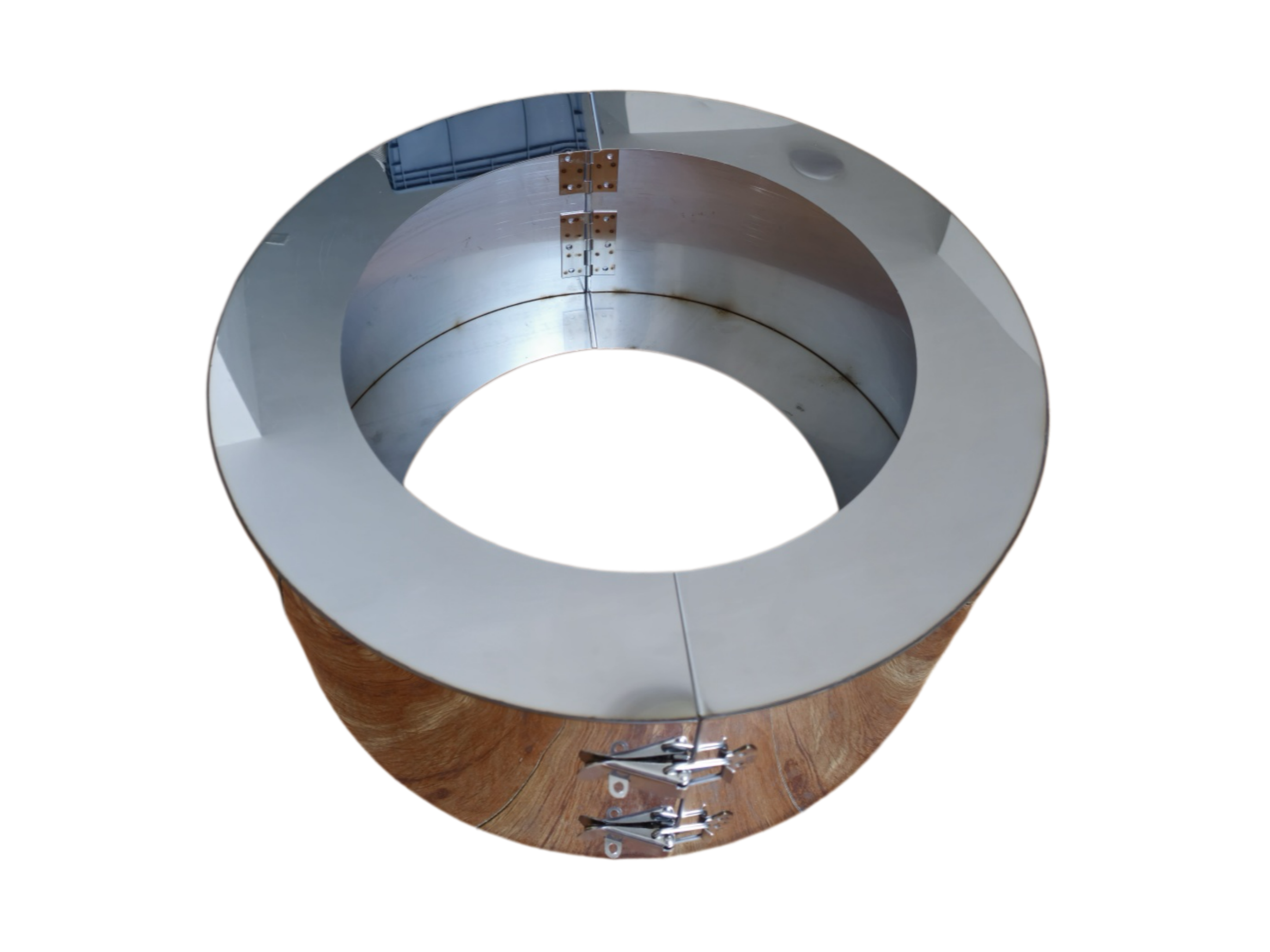
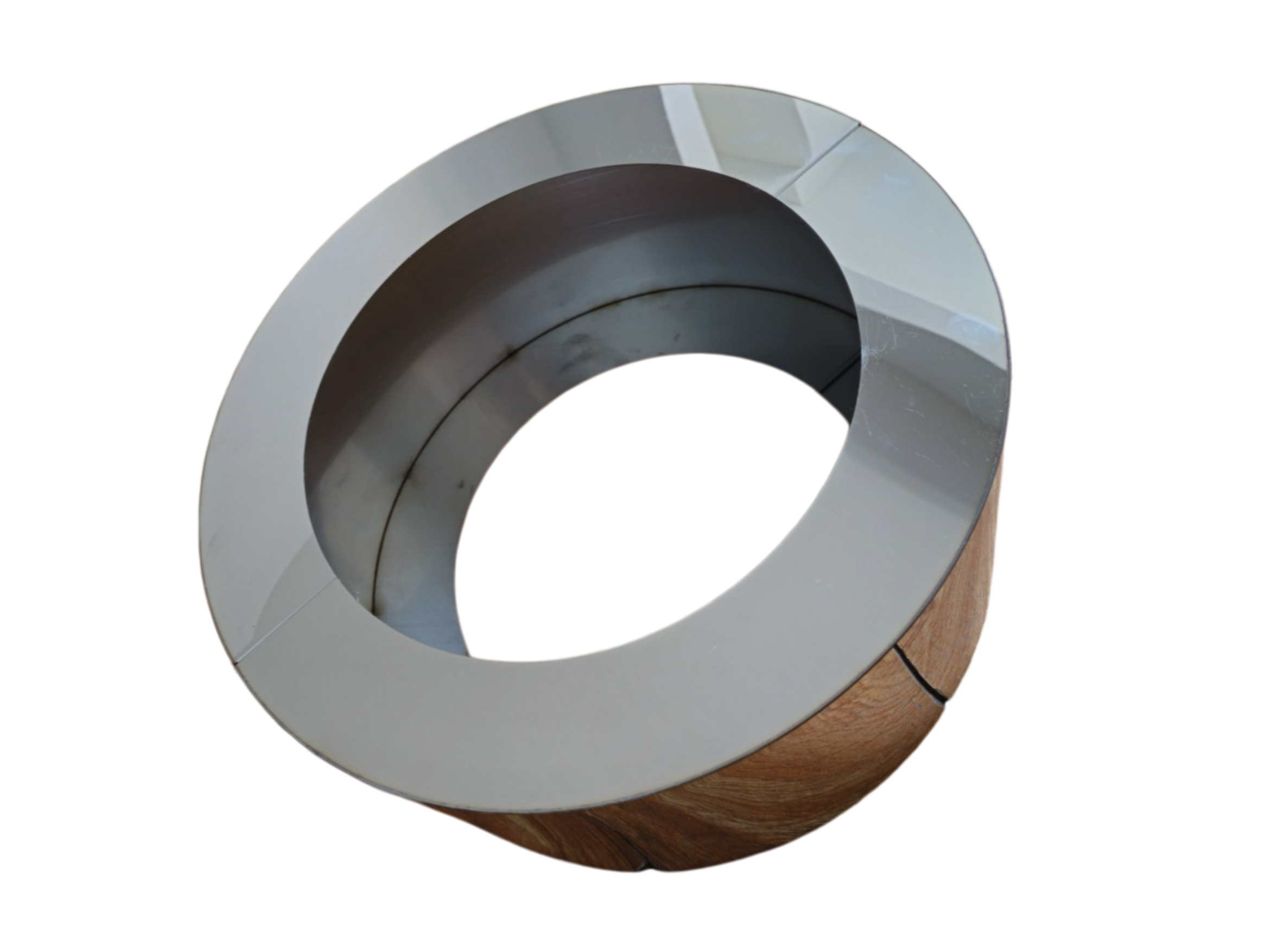
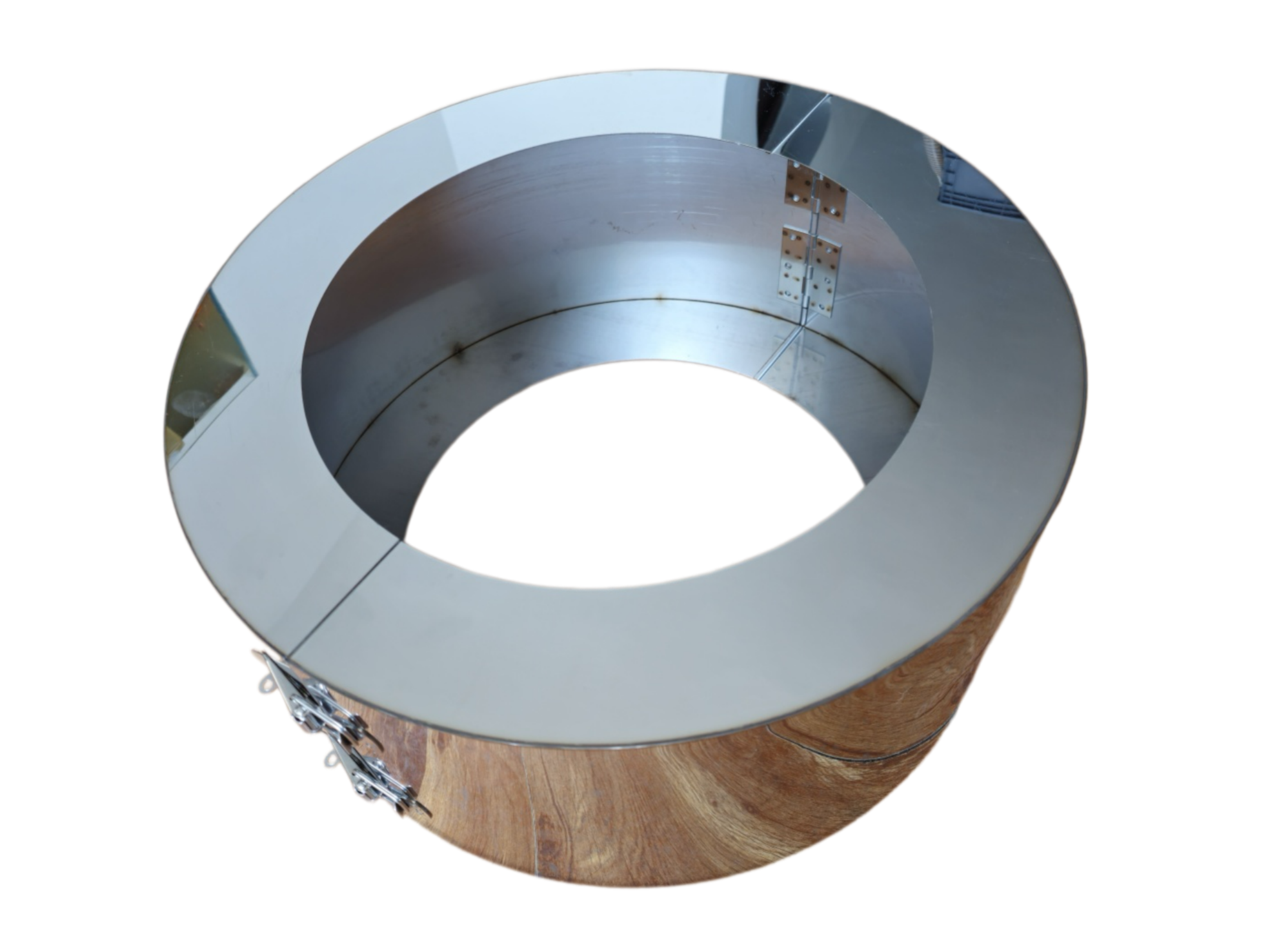
316SS Flange Protector
Brief:
Size: Suit for 10″ flange as per ANSI B16.47A
Rating of flange :2500LB
Materials: 316SS
Description
316SS Flange Protector (Safety Spray Shield) — Technical Data Sheet
1. General Description
This 316SS Flange Protector is a safety spray shield specifically engineered to enclose flanged pipe joints, valve connections, and other mating flanges. It prevents hazardous, corrosive, or high-temperature process fluids from spraying outward in the event of a flange gasket failure or leakage. The device directs any escaping medium safely to a drain or drip point, thus protecting personnel and surrounding equipment.
Manufactured from 316L (1.4404) or 316 (1.4401) austenitic stainless steel, the protector provides exceptional resistance to chlorides, acids, and marine environments. It is fully reusable and suitable for both indoor and outdoor installations. An optional transparent inspection window allows visual monitoring of the flange joint without removing the shield. Standard designs are compatible with ANSI, EN, and JIS flanges, covering pressure classes up to Class 300 (PN40), with higher ratings available on request.
2. Technical Specifications
Parameter Specification
Product Type Safety Spray Shield / Flange Protector
Body Material 316L Stainless Steel (1.4404) or 316 (1.4401)
Cover Style Two-piece clamshell with quick-release fasteners
Window Material Tempered Borosilicate Glass, PTFE, or Polycarbonate (optional)
Gasket / Sealing PTFE, Flexible Graphite, or FKM (Viton®) — depending on service
Fasteners / Hardware 316 Stainless Steel (bolts, nuts, washers, toggle latches)
Drain / Vent Connection 1/4″ NPT, 1/2″ NPT, or G1/4 (optional plug or open drain port)
Flange Compatibility ASME B16.5 Class 150–300, EN 1092-1 PN10–PN40, JIS 10K–20K
Size Range ½″ to 48″ (DN15 to DN1200) — larger sizes upon request
Operating Temperature -60 °C to +500 °C (-76 °F to +932 °F) (window & seal dependent)
Pressure Containment Not a pressure vessel; designed for atmospheric spray deflection
Corrosion Resistance Superior to 304SS, suitable for marine, chemical, and offshore use
3. Materials of Construction
Component Material
Shield Body (Halves) 316L Stainless Steel (UNS S31603 / 1.4404)
Inspection Window Ring 316L Stainless Steel
Viewing Window Tempered Borosilicate Glass (standard), PTFE, or Polycarbonate
Window Gasket PTFE or Flexible Graphite (high temp)
Half Body Seal PTFE or Fluorosilicone Sponge
Fastener Bands / Toggle Latches 316 Stainless Steel
Rivets / Clips 316 Stainless Steel
Drain Fitting 316 Stainless Steel, threaded
Note: All metallic components are fully traceable and supplied with material test certificates per EN 10204 3.1 upon request.
4. Performance Data
4.1 Environmental Resistance
316SS provides excellent resistance to:
Chloride-induced pitting and crevice corrosion
Seawater and marine atmospheres
Mildly acidic and alkaline solutions
Organic solvents and many chemical compounds
4.2 Temperature Range
Window / Seal Configuration Continuous Temperature Rating
PTFE Window + PTFE Seals -60 °C to +260 °C (-76 °F to +500 °F)
Borosilicate Glass + Graphite Seals -60 °C to +500 °C (-76 °F to +932 °F)
Polycarbonate Window + EPDM Seals -20 °C to +100 °C (-4 °F to +212 °F)
4.3 Spray Deflection Capability
The protector is designed to fully contain and direct flange leakages up to the flange’s rated pressure (e.g., Class 150 or PN16), provided the shield is correctly sized and securely fastened. The deflector does not function as a pressure vessel; it redirects the release to a safe location via the drain/vent port.
5. Key Dimensions (Example for ASME B16.5 Class 150 Flanges)
Custom shields are manufactured to match the exact flange outer diameter and bolt count. Typical dimensions are shown below.
Nominal Pipe Size Flange O.D. (mm) Shield Inside Diameter (mm) Shield Width (mm) Drain Port
½″ 89 92 65 ¼″ NPT
1″ 108 111 75 ¼″ NPT
2″ 152 155 90 ½″ NPT
3″ 190 194 105 ½″ NPT
4″ 229 233 115 ½″ NPT
6″ 279 283 135 ½″ NPT
8″ 343 348 160 ½″ NPT
10″ 406 411 180 ½″ NPT
12″ 483 489 210 ½″ NPT
14″ 533 540 230 ½″ NPT
16″ 597 604 260 ½″ NPT
18″ 635 642 280 1″ NPT
20″ 699 707 300 1″ NPT
24″ 813 822 350 1″ NPT
For EN 1092 PN16 flanges, DN1400 (approx. NPS 56″) shields are fabricated to order. Please provide actual flange O.D. and width.
6. Inspection & Testing
Test Item Specification / Procedure
Visual & Dimensional Inspection 100% inspection for material condition, dimensions per drawing, and weld quality (if welded construction)
Material Certification EN 10204 3.1 for 316SS shells, bands, and fasteners (optional 3.2 upon request)
Window Leak Test Dye penetrant check on window seal interface (for glass/PTFE units)
Fit-Up Test Random checks on standard sizes; all custom shields are pre-assembled on a dimensional fixture or customer-supplied flange
Surface Finish Pickled and passivated per ASTM A380 / A967 to restore corrosion resistance
7. Key Features
Superior Corrosion Protection — Manufactured from 316L/316 stainless steel, ideal for offshore, chemical, and wastewater environments. All hardware is also 316SS to prevent galvanic corrosion.
Rapid Installation & Removal — Split clamshell design with quick-release toggle latches or swing bolts allows installation in under one minute without breaking the flange connection.
Optional Visual Monitoring — Integrated transparent window (glass, PTFE, or polycarbonate) enables visual inspection of the flange joint for leaks, corrosion, or gasket condition without dismantling the shield.
Safe Leakage Management — The shield captures and redirects dangerous sprays or mists to a controlled drain location via a threaded bottom port, dramatically reducing risk to personnel.
High Temperature Capability — With borosilicate glass and graphite sealing, the protector can withstand continuous exposure up to 500 °C, making it suitable for steam, thermal oil, and high-temp chemical lines.
Reusable & Durable — Unlike disposable plastic protectors, the 316SS version is fully reusable even after exposure to aggressive media or high temperatures. It resists UV, ozone, and weathering.
Universal Flange Compatibility — One design covers multiple flange standards (ASME, EN, JIS) within the same nominal size and pressure class range.
No Flange Modification Required — The protector clamps around the existing bolt circle and does not require extra gaskets, longer bolts, or flange machining.
Drain/Detection Options — Standard drain port can be plugged, piped to a safe area, or fitted with a leak detection sensor (conductivity, pH, or float switch) for early warning.
8. Applicable Standards & Certifications
Category Standard / Reference
Material ASTM A240 / A182 for 316/316L; EN 10088-2 for 1.4404/1.4401
Design & Manufacturing ISO 9001 quality management system; designed following guidelines of ANSI/ASME B31.3 and European Pressure Equipment Directive (as applicable for safety accessories)
Flange Dimensions ASME B16.5, EN 1092-1, JIS B2220
Surface Passivation ASTM A380 / A967
Marking Permanently etched with size, material, heat number, and manufacturer’s logo
Fire Safe (optional) Graphite seals and metal parts ensure non-flammability; shield itself does not sustain combustion
9. Typical Applications
316SS flange protectors are widely used where flange leakage could cause safety hazards, environmental damage, or production loss:
Chemical & Petrochemical Plants — Acid, solvent, and hydrocarbon transfer lines
Offshore Platforms & FPSOs — Seawater, produced water, chemical injection, and hydraulic lines
Pharmaceutical & Fine Chemical — High-purity and aggressive media containment
Pulp & Paper — Chlorine dioxide, bleaching chemicals, black liquor
Water & Wastewater Treatment — Chemical dosing lines (sodium hypochlorite, ferric chloride, etc.)
Power Generation — Steam, condensate, cooling water, and fuel oil flanges
LNG & Cryogenic — With special window/seal configurations (316L retains toughness at cryogenic temperatures)
Marine & Shipbuilding — Bilge, ballast, and cargo lines
10. Ordering Information
To ensure correct fit and performance, please specify the following when ordering:
Item Description / Options
Pipe Size Nominal diameter (e.g., 3″, DN80)
Flange Standard & Pressure Class ASME B16.5 Class 150 / 300; EN 1092-1 PN16 / PN40; JIS 10K / 20K
Flange Outer Diameter Exact O.D. (mandatory for non-standard flanges)
Flange Thickness / Shield Width Width between flanges; shield width will be sized accordingly
Material 316L (standard) or 316
Window Type Borosilicate Glass, PTFE, Polycarbonate, or Solid (no window)
Seal Material PTFE, Graphite, or FKM (specify based on service)
Drain Connection Size and type (NPT, BSP) — plugged or open
Accessories Drain piping kit, leak detection sensor, colour coding, label engraving
Certifications EN 10204 3.1 certificates, NACE MR0175 (if required)
Example specification line: 3″ ASME B16.5 Class 150 316L Flange Protector, borosilicate glass window, PTFE seals, ½″ NPT drain with plug, toggle latch closure.
11. Important Notes
This technical data sheet describes a safety device designed for atmospheric spray deflection only. It is not a pressure-containing vessel and must not be used to enclose flanges that are subject to full pipeline pressure inside the shield without venting. The drain port must always be open or piped to a safe, unpressurized collection point.
Verify chemical compatibility of the 316SS shell and selected sealing materials with the process fluid in the event of leakage. While 316SS offers excellent broad-spectrum corrosion resistance, it may be attacked by certain concentrated acids (e.g., hydrochloric, hydrofluoric) at elevated temperatures. For such media, an alternative alloy or lining may be recommended.
The standard temperature rating is based on the window and seal assembly. For applications exceeding +260 °C, contact the manufacturer with full service conditions.
Dimensions shown are for reference. For critical fit, provide the actual flange outside diameter, bolt head/spanner clearance, and overall flange width to ensure the shield fits without interfering with adjacent pipes or insulation.
When installing on vertically oriented flanges or in outdoor locations, ensure the drain port is oriented downwards. Use an extended drain line if necessary to direct leakage away from the area.
The shield should be periodically inspected for signs of corrosion, pitting, or mechanical damage. Fasteners should be checked for tightness after temperature cycling.